
 Log in
See the 401(k) Tactical Allocation Model in Action
Review historical performance metrics, drawdown comparisons, and how the model adjusts in real market conditions
Recommended Articles

September 10, 2025
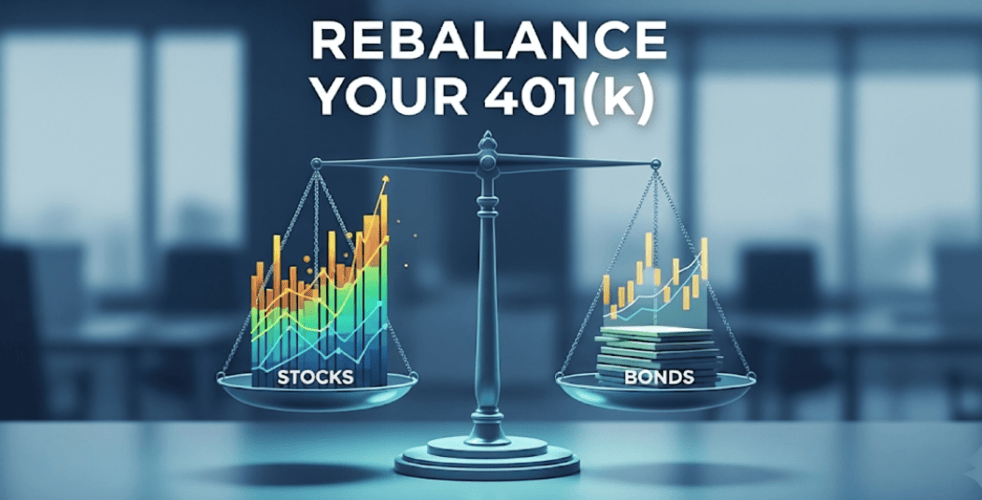
How to Rebalance Your 401(k): Smart Strategies for Growth & Safety
September 4, 2025
Strategic Vs. Tactical Investing: Key Differences & Your Best FitReady to raise your investing IQ?
Sign up for our Free Newsletter to access the best investment information money can’t buy.

Published On: January 6, 2026
Last Updated: February 23, 2026
Most people assume a seven-figure retirement balance requires a six-figure salary, a lucky stock pick, or decades of white-knuckling through market volatility. The reality is far more accessible and far more instructive.
According to Fidelity Investments’ Q2 2025 retirement analysis, there are currently 595,000 401(k) millionaires in the United States, an all-time high. These are not mostly hedge fund managers or tech executives. Many are teachers, nurses, engineers, and middle managers who simply made smart, consistent choices over time and never stopped.
The defining characteristic isn’t income. It’s behavior. Specifically, three behaviors stand out: contributing consistently, avoiding panic-driven decisions, and crucially protecting accumulated gains from the kind of deep market losses that can erase years of progress in a matter of months.
This guide breaks down exactly how 401(k) millionaires think and invest, the hidden threat that derails most savers, and how a data-driven, tactical approach can dramatically improve your odds of joining their ranks.
The habits of successful 401(k) investors are well-documented, and they’re less glamorous than most people expect. There’s no secret portfolio. No market timing genius. What separates them comes down to discipline applied consistently over decades.
Automatic payroll contributions remove the temptation to skip a month. When saving happens before the money hits a checking account, it becomes invisible and effortless. This single habit, maintained through recessions, job changes, and life disruptions, is arguably the most powerful wealth-building tool available to ordinary investors.
Contributing at least enough to capture the full employer match is the closest thing to a guaranteed return that exists in investing. If your employer matches 5% of your salary, failing to contribute that much is, in effect, declining a 100% return on that portion of your money.
A 1% annual increase in your contribution rate timed to coincide with a raise or promotion compounds into a significant difference over 20 or 30 years. You’ll barely notice the change in your paycheck, but your retirement balance will.
This is where most guides stop, and where the most important nuance begins. Staying invested is essential. But staying invested without any strategy to manage downside risk is a different matter entirely. More on this shortly.
The key insight from Fidelity’s data:
Most 401(k) millionaires are in their 50s and 60s, but younger workers are now reaching that milestone earlier than ever, largely because they started sooner and managed volatility more intelligently.
Compounding is straightforward in theory and genuinely staggering in practice. The table below illustrates what consistent monthly contributions at a 7% average annual return can produce over a working career:
| Starting Age | Monthly Contribution | Balance at 65 (7% Return) |
| 25 | $500/month | $1.26 Million |
| 35 | $1,000/month | $1.13 Million |
| 45 | $2,000/month | $1.09 Million |
The numbers confirm what financial planners have long argued: starting early is more powerful than contributing more later. A 25-year-old saving $500/month will, all else being equal, out-accumulate a 45-year-old saving $2,000/month despite contributing a fraction of the total dollars.
But notice what these projections assume: consistent growth, uninterrupted by catastrophic losses. In practice, a 40% portfolio drawdown, which is exactly what happened to many 401(k) accounts in 2008, requires a 67% subsequent gain just to return to break-even. That’s not a minor setback. That’s years of compounding erased.
Which is why the next section may be the most important thing you read about retirement investing.
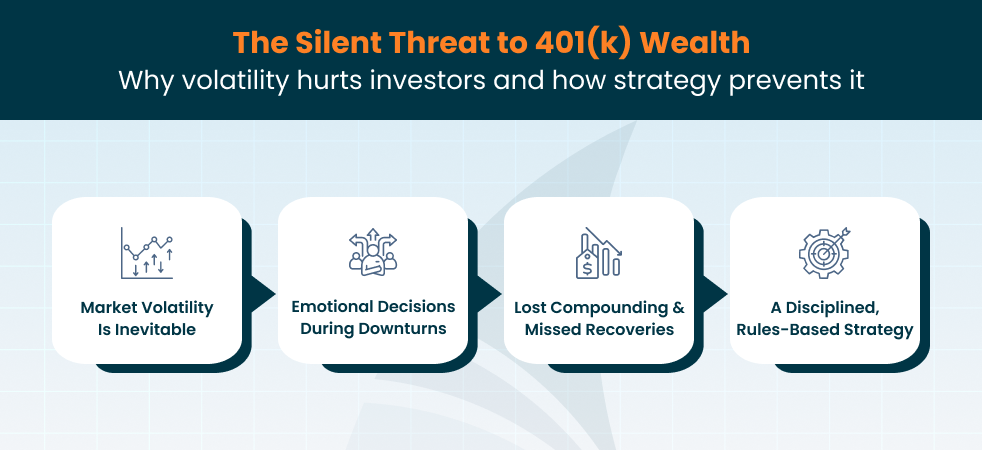
You can do everything right, contribute faithfully, capture the full match, diversify appropriately, and still fall significantly short of your retirement goals if you absorb the wrong losses at the wrong time.
This is the threat most retirement guides underemphasize. Market volatility isn’t just uncomfortable; it’s mathematically destructive to long-term wealth when losses are large and come at critical junctures.
In the 2008 financial crisis, the average 401(k) balance dropped by roughly 31%. Many investors who panicked and sold at the bottom locked in those losses permanently, then watched helplessly as markets rebounded without them. But even those who stayed fully invested lost years of compounding time waiting to return to their previous balances.
The scenario that keeps retirement planners awake at night is called “sequence of returns risk,” the possibility that a major market decline arrives just before or just after retirement, when your account balance is at its highest. You have the fewest working years left to recover. A 40% loss at 62 is categorically different from a 40% loss at 35.
Traditional target-date funds and passive index investing operate on a simple premise: stay the course, ignore the noise, and time in the market will compensate for everything else. For many investors, in many market environments, this works reasonably well.
But it has a structural weakness: it treats all market conditions the same. A rules-based passive portfolio holds the same allocation whether earnings are accelerating, credit markets are seizing up, or leading economic indicators are flashing warning signs. It cannot distinguish between normal volatility and a structural bear market.
The result is that passive investors absorb the full force of every major downturn and then wait, sometimes for years, to recover.
This is the gap that tactical, data-driven investing is designed to fill.
What if your 401(k) could respond intelligently to market conditions, reducing exposure when risk is elevated, and re-engaging when conditions improve without requiring you to predict anything?
That’s the principle behind tactical investing, and it’s the foundation of the approach used in Model Investing’s 401(k) Allocation Model.
Unlike passive strategies that hold fixed allocations regardless of market conditions, a tactical model follows objective, data-driven signals that monitor trend strength, momentum, and risk indicators across the market and adjust portfolio exposure accordingly. When conditions favor growth, the model stays fully invested to capture upside. When risk indicators deteriorate, it rotates toward defensive positions to limit downside.
This isn’t market timing in the speculative sense. There’s no crystal ball, no predictions, no guessing. It’s a systematic, rules-based process designed to do one thing: keep your portfolio from absorbing the deep, compounding-destroying losses that passive strategies routinely accept.
The compounding math makes the value of drawdown reduction concrete. Avoiding a 40% loss doesn’t just save you the loss itself. It saves you the recovery time, the psychological toll that often causes investors to make poor decisions at market bottoms, and the years of growth that would have been generated by capital that was instead sitting at a loss.
Investors who experience smaller drawdowns don’t just recover faster, they compound from a higher base for longer. Over a 20- or 30-year retirement savings horizon, that difference can be measured in hundreds of thousands of dollars.
The tactical advantage in plain language:
When markets are healthy, stay invested and grow. When conditions deteriorate, reduce exposure and protect. No emotions, no predictions, just disciplined rules executed consistently.
Model Investing’s 401(k) Allocation Model applies exactly this logic, with a full track record of risk, return, and drawdown metrics available for review. If you’ve ever wondered what a professionally managed, tactically adjusted 401(k) allocation would have looked like through 2008, 2020, and the 2022 bear market, the data is there.
Review historical performance metrics, drawdown comparisons, and how the model adjusts in real market conditions
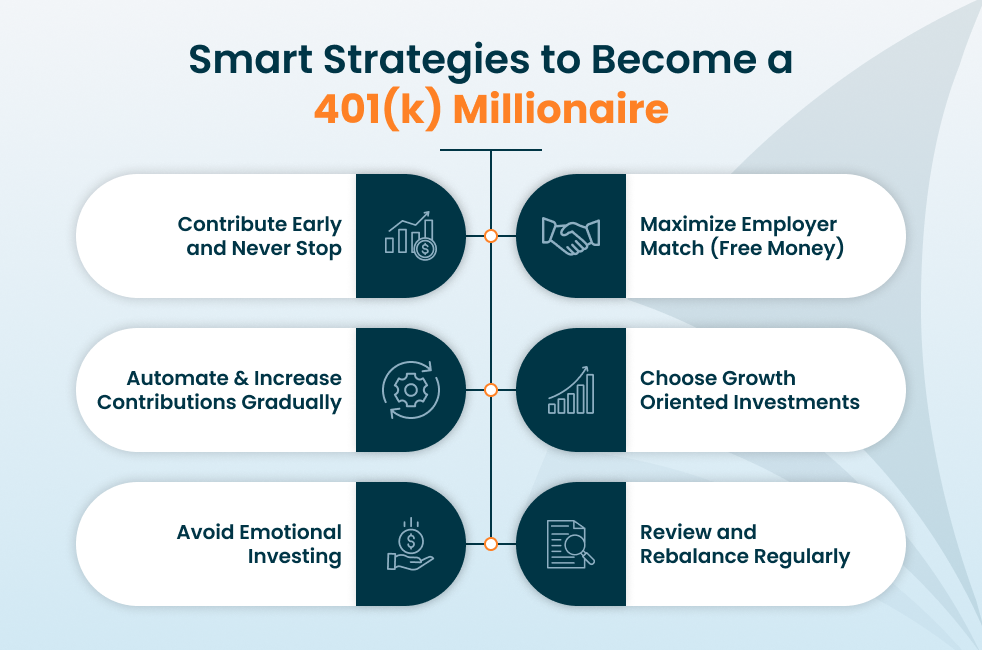
Reaching seven figures in a 401(k) doesn’t require extraordinary income or extraordinary luck. It requires a combination of consistent habits, intelligent allocation, and a strategy built to survive the market environments that derail most investors. Here’s the playbook.
The most valuable asset you have in retirement savings is time. Every year you delay is a year of compounding you cannot recover. The dollar amount matters far less than the consistency. Open the account, set the contribution, and automate it. Revisit it annually, but never stop.
Employer matching is, without question, the highest-return investment available to most 401(k) participants. A 5% match on a $70,000 salary represents $3,500 of free money annually, money that, if left on the table for a decade, represents tens of thousands of dollars of lost wealth. Contribute at a minimum, whatever it takes, to receive the full match before directing money anywhere else.
Most 401(k) plans allow you to schedule automatic annual contribution increases. Setting this to 1% per year costs almost nothing in take-home pay, especially when timed to a raise, but its impact over a 20-year horizon is substantial. This is the kind of frictionless habit that quietly separates seven-figure retirement balances from five-figure ones.
Bonds and stable value funds have their place, particularly as retirement approaches, but over-weighting them during your accumulation years is expensive. Equities are the primary engine of compounding in a retirement portfolio. The appropriate response to market risk isn’t to abandon equities; it’s to manage that risk intelligently, which is precisely what a tactical allocation strategy does.
The research on investor behavior is unambiguous: retail investors systematically underperform the very funds they’re invested in, because they buy after markets rise and sell after markets fall. The antidote isn’t willpower, it’s systems. A tactical, rules-based model like Model Investing’s 401(k) Allocation Model handles the adjustment decisions for you, based on data rather than fear or greed.
When the discipline is built into the strategy, emotional mistakes become structurally harder to make.
Markets move, and over time, they will drift your portfolio away from your intended allocation. A portfolio that was appropriately balanced at the start of a bull market may be dangerously over-concentrated in equities by the time that bull market ends. Annual or semi-annual rebalancing keeps your risk profile aligned with your goals, not with wherever recent market performance has pushed it.
A surprising number of investors who crossed the seven-figure threshold during the bull markets of the 2010s and early 2020s watched their balances fall back below $1 million in subsequent corrections. Accumulation and preservation require different thinking.
As your balance grows, the arithmetic of percentage losses becomes increasingly significant. A 30% loss on a $200,000 portfolio costs you $60,000. The same percentage loss on a $1,200,000 portfolio costs you $360,000, six times as much in absolute terms, and potentially represents years of contributions.
This is why the shift from pure accumulation to defensive growth is not optional as your balance scales. You’ve worked too hard to let a single market cycle undo a decade of progress. A tactical allocation model doesn’t just help you get to $1 million; it helps you stay there and keep compounding.
The path to 401(k) millionaire status is not mysterious. It’s consistent contributions, compounding time, intelligent allocation, and a strategy that protects your progress when markets turn against you.
The investors who reach seven figures and stay there share one defining trait beyond discipline: they don’t absorb catastrophic losses. They’re not necessarily smarter than other investors. They’re better protected. They’ve built a strategy that doesn’t require them to predict market crashes, one that simply responds to deteriorating conditions before those conditions become portfolio-damaging events.
Model Investing’s 401(k) Allocation Model was built to provide exactly that kind of disciplined, data-driven protection with a transparent track record, real allocation guidance, and a framework that keeps working whether markets are climbing or correcting.
If you’re serious about maximizing your 401(k)’s potential and serious about protecting what you’ve already built, reviewing the model is the logical next step.
See how Model Investing’s tactical 401(k) Allocation Model has navigated real market conditions and how it can work for your retirement strategy.
As of Q2 2025, Fidelity Investments reports 595,000 401(k) millionaires, an all-time high.
Most 401(k) millionaires by age reach that milestone in their 50s or early 60s, after decades of consistent saving and compound growth.
However, many younger investors, especially those in their 30s and 40s, are joining the millionaire 401(k) club earlier thanks to automatic contributions, higher limits, and smarter, more tactical portfolio management.
Currently, only about 1.5 to 2 percent of all 401(k) participants have reached millionaire status.
But that percentage of 401(k) millionaires continues to rise each year as more savers stay invested through market cycles and adjust allocations rather than panic-selling during downturns.
It’s never too late to start building toward a million-dollar 401(k).
If you’re beginning in your 40s or 50s, focus on three core steps:
That depends on your lifestyle, location, and retirement goals.
For many, a $1 million 401(k) balance provides a solid foundation when combined with Social Security, pensions, or IRAs.
The true goal isn’t only hitting the seven-figure mark. It’s maintaining financial flexibility, income stability, and peace of mind throughout retirement.
Not at all.
Most self-made 401(k) millionaires built wealth through discipline, time, and behavior, not luck.
They contributed through recessions, avoided emotional selling, and rebalanced consistently.
Smart systems like our data-driven tactical models help everyday investors follow those same principles automatically.
False.
While higher income helps, the real drivers are consistency and longevity.
Even moderate earners who invest 10 to 15 percent of their paycheck steadily for 30 years can reach $1 million or more, especially when guided by tactical, adaptive investment models that protect growth over time.
The Model Investing Research Team, led by Chief Investment Strategist Matthew Kerkhoff, is a group of finance professionals, data scientists, and software engineers committed to helping individuals make smarter investment decisions. By combining advanced analytics, behavioral science, and market expertise, they simplify complex financial concepts and deliver clear, actionable insights. Their mission is to empower investors of all levels with the knowledge and tools needed to achieve financial stability and long-term success.
Read More
An innovative approach for eaming higher returns with less risk
Download Report (1.2M PDF)You don’t want to look back and know you could’ve done better.
See PricingPosted in